If ignorance is bliss, should I be dafter to be happier?
I am a strong supporter of mental powers. Philosophy, argumentation, thinking in general. One might even argue emotions should be subdued by intelligence, as emotions do not obey the rules of logic. It is no secret that emotions fog things up, they always have and always will.
Then again, emotions are required for joy, for exuberance. They are emotions. This would indicate that emotions are an integral part of eudaemonia.
“If Eudaimonia, or happiness, is activity in accordance with excellence, it is reasonable that it should be in accordance with the highest excellence; and this will be that of the best thing in us.” - Aristotle
But doing things as well as one is able to requires doing it with wit, with intelligence, with a sound mind. Pure effectiveness can only be improved upon using the brain to figure out better methods of doing something. A paradox arises, which properly explains why either extreme is utterly useless. But a golden middle has to exist, an optimal ratio between mind and heart. How far off from that optimal ratio is our general way of thinking, how to fix our thinking to allow complete happiness?
Then again, if ignorance is bliss, am I perhaps better off not knowing?
“The universe puts us in places where we can learn. They are never easy places, but they are right. Wherever we are is the right place and the right time. The pain that sometimes comes is part of the process of constantly being born.” – J. Michael Straczynski
We make plans, sometimes far into the future. We believe that everything will turn out the way we want it to, or expect it to. We love it when our plans come together, but sometimes they do not, sometimes they simply refuse to give in to our hopes and dreams, they insist on making our lives more complicated despite our desire for simplicity.
One might ask if it is fate or karma that creates these obstacles in our path, that makes us trip and fall when we finally achieve a stable stride. There is not much else it could be but meaningless coincidence. That could be a hard medicine to swallow, to accept that our happiness and hope are so often ruined by pure chance that just happens to strike when we feel most hopeful. As if it were done out of spite.
Nevertheless we try to cope with these setbacks, to overcome the difficulties. Sometimes accept the new conditions, as difficult as it is to accept the death of long-lasted hope. It may feel as if our souls are being crushed by an unstoppable force, but we always get back on our feet and keep going. There is no point in surrender, only in trying again. We have to stand up and continue along our path of life, reluctance to do so would mean defeat, humiliation, and the death of our spirits. We must continue, as we have no other course of action. We need to go on, because we choose to.
Some possible definitions I came up with to get some useful books.
1. The purpose of life.
The purpose of life is to give each individual an opportunity to act according to one’s abilities in order to achieve personal mental satisfaction upon life’s end.
2. The essence of the Universe
The Universe is a bunch of huge objects kept together by non-existent ones.
3. The limits of human abilities
A human being can do whatever one really tries to. Very often people try to fail.
4. Faith
Faith is a torch that gives people the bravery to test the limits of one’s abilities even during the darkest of times.
5. Future
The future is the consequence of our present and past actions.
The one way I am willing to listen to One Direction. A lot. Don’t ask me why one of them rubs the piano.
Objects in space.
Whenever you watch a movie that has really cool fake laser weapons (such as the laser blazer), you get to see the oddest ways lasers can hit something. Generally, the laser hits an object and the object disappears (or shrinks or grows), but nothing around or behind it is affected. Even if the laser is a tiny one, the entire object is hit, instead of a small part of it that is actually being hit by the laser. It is a simple trick of movie magic, a trick that has caused few questions about its obvious fakery. Why is that, one may ask.
It is because the general way of thinking about space around us is object-based. We perceive panes of glass as whole objects, not as results of small grains of matter. The same goes for couches, bags, even trees. Even when we know the objects are multilayered, consist of many different substances, we still think of them as (relatively) large objects. A book is a book, not a collection of paper sheets, a tree is a tree, not a mess of bark and leaves
This is merely an example of how used our brains are to simplifying things, generalizing everything and ignoring unique traits. For us, people are very similar and, excluding different looks and sounds, practically indistinguishable. Sure, there are small nuances that trigger interest or disinterest that we manage to recall about people, but nothing really deep. Very rarely do some people come along who we learn to know closely, their ambitions, logic of thinking, oddities of their sense of humour, detailed mannerisms, their logic-to-emotion ratio, even their mental connections. These are the few people we think about as abstract beings, something more than general people. These are the people we grow to care about.
“3. Thus the good fighter is able to secure himself against defeat, but cannot make certain of defeating the enemy.
4. Hence the saying: One may know how to conquer without being able to do it.” – Sun Tzu
This applies very well to most situations, including political fights. The problem with Romney is that he is a businessman, he wants to lead the country as if it were an enterprise. There is nothing inherently bad about the plan as the things that make a business successful are the same things that make a country successful: happy employees and clients, motivation to contribute in the employer’s benefit, economic and political stability, innovation, you name it. The problem with it lies in the size – Romney wants to lead the United States, an enterprise the size and diversity never seen before. He would need very autonomous branch offices, even branch offices of branch offices, which would micromanage certain districts; he would need regional governments that have almost no limitations. Any constraints upon their operation decreases their effectiveness as every area is different, they should be governed differently. And then they have to be willing to work together, which is yet another big problem.
The difference between branch offices and local authorities is that the company’s head office is supposed to nurture the branch offices to make them as productive as possible. Since there is no play for power (or very little room for it), that is not a concern. In the case of local authorities is that the state has to limit them from growing out of hand. Anyone who becomes too influential will start hindering the free operation of the state.
“Half of them are your enemies and the other half are the kind that makes you prefer your enemies.” –YPM on regional governments
Regional governments are not like branch offices, you cannot appoint anyone you want to lead them. The governors are chosen by the people, and they fall into two very similar, yet violently conflicting parties. If each branch office has different aims, principles and ideals, managing the whole system from a central body becomes a fool’s quest. You would end up with a horrible case of Buridan’s donkey – instead of two stacks of hay you would have over fifty of them! And just one ass – the country – that is being drawn in every direction, never actually getting anywhere before dying.
“I mean just imagine if you put defence in the hands of local authorities. Give the local councils a hundred million each and ask them to defend themselves, we wouldn’t have to worry about the Russians, we’d have a civil war in three weeks!” – YPM
It rarely results in anything practical, but it often confuses the sprouts out of everyone involved in the debate. I’ve covered it before, and can yet again, as reasons are plentiful. I’ve covered the aspect of understanding others and simply asking ‘Why?’ about everything that one does not understand, it is an instrument of learning. But it is also an instrument of doubt, and doubt is good.
Probably all of you remember the KONY 2012 campaign that looked like either a sloppy rendition of pre-Afghanistan events[1] or a well executed diversion[2]. For a moment shortly after the video became a hit, a lot of people were sure that Kony would soon meet his premature demise due to an unexpected bullet originating from a rifle being actively used by American troops. Then came the people who doubted the positive result of such an invasion, who doubted what the campaign was telling them, doubted so much that they dug further and spoke up. Not in defence of Kony, but against the amorality of an invasion. Some were idealists (killing is bad by default), some were utilitarians (a war would cause more harm than the absence of it), some were just plain odd (killing him would make us no better than he is). But they all doubted what was said to them, what a huge number of people took as solid information, when it was, in fact, mere rumour. And that is what philosophy tries to teach, nothing can be known before it is pondered about. With simple things, such as knowing what a lamina arcus vertebrae is, pondering is rather useless because there aren’t that many alternative options. But when morality, principles or emerging sciences are involved, thinking through every new bit of information helps understand it a lot better.
Secondly, modern philosophers have an important role very similar to science fiction authors – inspiration. Asking ‘what if this were possible?’ aids scientists foresee possible implications of emerging technologies, thus helping put these new technologies into practise faster and safer, and it is a source of inspiration for researchers. If it wasn’t for Star Trek, maybe NASA would not be trying to build a warp drive[3]. You might argue that this is the work of science fiction authors, but there isn’t much of a difference between such authors and philosophers. Both theorize about possibilities, judge their viability, take into account human nature, people’s hopes and dreams, both wonder ‘What if…?’. Let’s not forget, there are no career philosophers anymore who would simply lie down at a nice tree and think for hours, that is left for literature majors. But there are active writers that dream big and try to inspire people to do better. Just think about Neal Stephenson and his space elevator or CLANG.
Philosophers used to be the most respected educated professionals that led local life and educated others that followed centuries after they had already passed away. They turned into natural philosophers, they created the concepts of physics, chemistry, biology, mathematics, etc. Then each small area of science started spawning their own specialists, general philosophers lost their significance. They changed, from simple dreamers who taught people to think to thinkers who teach people to dream. They have always had sidegigs, they always will. Nowadays we hardly notice them because they do not fit the traditional idea of a philosopher, but they are there, silently progressing the way we think. In a way we need them to keep moving forwards.
I’ve previously talked about the effectiveness of an atmospheric nuclear attack (strike the electronics, not the people), now it is time to talk about guerrilla warfare.
It is the basic cell-based scheme that has caused Americans problems for so long. It is the way terrorists and spies operate – small groups of people working towards the same goal, never connecting unless it is absolutely necessary. The obvious downside is that the plans of two groups could conflict with one another, which is why generally there are very few groups within small distances. Large-scale attacks are hard to carry out as those usually require large numbers of people. But some attacks, such as 9/11, need only a few people. A couple of people per plane will do the trick.
However, as 9/11 so obviously demonstrated, the cell-based strategy means that each cell goes unsupervised. As they go unsupervised, they have free range in what they do. If they decide to opt for a shocking attack in a densely populated area, they are just asking for trouble – the retaliation probably cost the terrorist agenda more harm than good. Even when considering that the violence of the first response spawned countless support groups all over the world that now endanger almost every single city in the ‘Western world’, the ideal that used to be fought for is gone. Religious freedom is less of a priority than survival.
The upshot of cell-based warfare is the lack of connections. If one cell becomes compromised by infiltration or a simple old-fashioned mess-up, the other cells cannot be taken down using the information gained from the first group. Since cells operate as divisions, they do not use the same suppliers, which means that when a supply chain becomes compromised, the organization as a whole suffers minimally. It is the same concept as hiding money in more than one place in the same room – the likeliness of all of it being found decreases with every hiding spot. Some groups can specialize is espionage – seeking out potential targets, publishing secrets that damage the hostile side’s reputation. Some groups could use all that newly published information for campaigning against the hostile group’s higher echelons of power, thus causing morale-induced unrest, increasing the number of traitors and deserters, forcing the hostile leading organization to be more careful with what they do and say – everything could be used against them very actively. Then there are cell that could target the positions of power directly, replacing those with their own people. Once all those spots are covered, a simple coup will end hostilities. The last class of cell would be the ones using the direct approach. When the espionage cells share information about possible targets, these are the people that take action against these targets. Eliminate energy supplies, take down cell towers, disrupt sanitary services (such as water pipelines, waste disposal), eliminate enemy command structures, etc. They make the ‘fire sale’ happen.
This is what makes guerrilla fighting so effective – the lack of connections. When one domino falls, the rest do not follow, they retaliate. And when many groups retaliate for the fall of a single group, it is sometimes better to leave those groups be at peace. Which is the case of Afghanistan – one small attack was retaliated by pretty much the whole of NATO forces (by UN command), which cause an even more widespread problem. In this form, not even the wise can make plans against it. Sometimes even modern military leaders and presidents could learn a thing or two from Sun Tzu.
“There is a greater darkness than the one we fight. It is the darkness of the soul that has lost its way.
The war we fight is not against powers and principalities – it is against chaos and despair. Greater than the death of flesh is the death of hope, the death of dreams. Against this peril we can never surrender.
The future is all around us, waiting in moments of transition, to be born in moments of revelation.
No one knows the shape of that future, or where it will take us. We know only that it is always born in pain.”
The future is unknown and unforgiving, keeping up optimism is oftentimes a difficult challenge. Some people have to remain optimistic about the future to do what they do best[1], but many others can be quite content with realism. Yet often enough, all we can do, is hope.
Hope is what leads progress, we hope that everything works out without a hitch. Then again, if it does not, we can fix the hitch and hope there are no more problems. It is the tried and true method of experimentation. But to make any progress, we need to test new things, broaden new horizons. I would gladly write about it, but doing so would be redundant as recently I came across a piece of writing about the very subject of the present lack of ambition and hope that has caused the lack of great discoveries of late. Since it is a relatively long (though very interesting) text, I shall leave you to it and I’ll be back soon. Enjoy.
Manipulation is generally considered unethical, even though the word encompasses much that is completely logical and beneficial. Regardless of purpose, the result of a successful manipulation is a person that does what he or she wants. The only difference from ‘normal’ situations is that the person in question just found out that he or she wants to do that what he or she is persuaded to want to do. ‘Manipulation’ does not specify whether the newly intended action is harmful or beneficial to the ‘victim’, oftentimes the victim never finds out that he or she has been coaxed into something unknowingly.
To manipulate is easy, the techniques vary from simple thumbs-ups at the right moments to knowing exactly what makes a person tick. Less important manipulations can be carried out with a cold approach, but these are the least useful. To do something of use, one ought to contemplate on how to gain the target’s trust, sometimes even respect. Different people respect different things, some appreciate power, some knowledge, some strength, some the ability to remain cool regardless of pressure. Unfortunately, there is a fine line between establishing respect and showing off – being overwhelming can cause unwanted fear and attention. It is usually best to be almost equal but a little better than the mark in the area of targeted respect. People tend to be wary of overpowering forces, causing distrust and scepticism. Anything too weak and you get stomped on, disregarded. Superficial equality is a lot easier to achieve when you go about your life assuming everyone else is at least as good as you are, unless they want to help you. After all, you are generally on the same boat with many different people who have come to be there using different paths for different reasons, but they have all made it to the same place you have.
Gaining trust is a lot more difficult than gaining respect. Respect is all about what you have done in the past and what you want to do in the future, trust is all about the present. It’s about being not too persistent, and not too cold. It’s about not lying, but also about knowing when to share personal information. It’s about being human. It is the general approach to making long-term friends squeezed into a shorter timeframe. The upshot is that one probably has enough practice by human interaction, the downshot is the bluff – by making a person trust you, you learn a lot about that person. You probably become friends with that person, hence it may be morally difficult to manipulate the target resulting in his or her harm.
However, there is one approach that works with most sentient life forms whether you know them closely or not – the direct method. Explaining to a person argumentatively why a certain course of action is for the best not only reaches the intended result, but it also teaches the ‘manipulator’ to see situations from somebody else’s perspective. This helps the success rate of any future persuasions and sometimes teaches the target analytical thinking, therefore assisting him or her make better future decisions. In this case, manipulation is actually a win-win action.
All in all, manipulation is essentially persuasion. It does not define the maliciousness of intent, it does not define the precise method involved, which is exactly why argumentation is an excellent method. However, if the intent is somewhat less than friendly, it is better to use the art of manipulation on strangers or someone you don’t mind no longer being friends with. It is a powerful weapon and as such has to be handled with care for the danger of an unpleasant backfire. Never mess around with people you care about, not even if they are new acquaintances.
"We are no longer particularly in the business of writing software to perform specific tasks. We now teach the software how to learn, and in the primary bonding process it molds itself around the task to be performed. The feedback loop never really ends, so a tenth year polysentience can be a priceless jewel or a psychotic wreck, but it is the primary bonding--the childhood, if you will--that has the most far-reaching repercussions."
I have previously mentioned gaming[1] as a minor element in other topics. However, after I saw an article[2] about a new element of education, I began to wonder. Computers have become a crucial part in our everyday culture, just like numbers, languages, music, etc. These subjects are taught to children and used for further educational purposes – you cannot know physics without knowing maths, you cannot know chemistry without knowing language, music helps remember things by acoustic association. And computers help teach every single one of these.
At school, when a teacher states a problem that you have to solve, it usually has about one solution, rarely there are more. It is a linear cycle where the pupil cannot consider the effectiveness of different approaches to problems as there aren’t enough options for the effectiveness to matter. In a way, it constricts creative thinking and independent learning. But take a standard 4X (explore, expand, exploit, exterminate) game, such as the classic Sid Meier’s games (SMAC, SMAX, Civilization, Colonization), you get countless options in every single game. You can focus on research, economy, warfare, diplomacy or population, while taking care of every unfocused area. There are different ways to succeed in the focused area. Besides managing one’s own ‘empire’, one has to keep an eye on and consider reactions to the opponent players’ strategy, random events such as floods, market crashes, sudden wars, to name a few. It therefore teaches maths in connection with economic thinking, language as the games tend to have advanced vocabulary (ambivalent, omniscient), even history as 4X games almost always have a storyline that is somehow connected to real events (Colonization is a great example with the founding fathers and whatnot), adaptive thinking and quick decision-making (4X games are usually turn-based so quicker turns means more gameplay per time unit). There is also a fierce competitive element, yet usually cooperation is key, thus it also teaches teamwork – being magnanimous towards a weaker player can pay off later on. The games end when either the player or the player’s ally/allies complete a specific task (ally all nations/be the only one left/be the first one to become an independent state/be the first one to go to space/…), after which the player’s skills are evaluated and a score is given that shows his or her efficiency. By learning new strategies and reconsidering micromanagement techniques the player can improve the score and actually see how he or she is learning to think creatively. The other possible ending is defeat, either by running out of human resources or somebody else completes a specific important task before the player. In this case the player is prompted to try again and learn from his or her mistakes. A simple 4X game does not only teach what to think, but also how to think. But 4X games are surprisingly rare and most of the good ones are already abandonware.
Coming to adventure/mystery games, such as Broken Sword, it does not take a genius to figure out that these teach logic (obviously excluded in the Discworld games), because one the one hand the player has to collect clues and figure out what has happened, what is going happen and why, on the other hand he or she has to interact with different types of people (from diligent guards and violent thugs to flirting archaeologists and French journalists), decide how much to trust them, how to get as much information out of them as possible or how to get out of a sticky situation while avoiding resorting to violence. It teaches common human interaction, people’s wants and fears, often enough it teaches about different real cultures and sometimes about the history of these cultures. Learning all that while having fun sounds like a pretty sweet deal.
Going on to racing (Colin McRae) and shooters (Death to Spies), there isn’t much to say. All they teach is quick reflexes, sometimes teamwork, but more importantly, they teach human psychology. In a typical shooter, the player has to assume that every opponent is at least as good as him or her in terms of accuracy – it boils down to lucky shootouts. Unless you want an edge, something to tip the odds in your favour – being sneaky, surprising the enemy, concealing oneself to avoid detection, anything a typical opponent might not expect. However, every time a trick is used, the chances of it working drop significantly and the trick can start working against the player. That means that the moves have to be innovative and randomized. Not to mention that the player can expect opponents to expect a used trick, which can easily be used against the opponents. By thinking about what your opponents are thinking you can learn to outwit them. Basically it is a simple case of chess with a lot more immediate action. In racing games, reacting to unanticipated corners or obstacles is an important part, but to win, efficient driving is a must. By this I mean acquiring the proper techniques to keep up the average speed in sharp turns by braking exactly at the right time, moving along the edges that allow larger curves in corners, hence allowing for turns at greater speeds. It takes a lot of learning to master any racing game.
There are a lot more types of computer games out there, such as simulation (The Sims) that teach time-planning, basic relationships, the concept of death, strategy games (Gettysburg!) that teach prioritizing, efficiency (again), awareness and quick reaction, and arcade games that teach quick, methodical thinking. There are also genres that have gone unmentioned, such as RPGs, due to the small fact that I have little experience with good RPGs. The main purpose of computer games is entertainment, but any really good computer game also teaches the player something new. The problem with really good games is that they are addicting, but without persistent trying, how could they keep teaching? A single game of Patrician 2 (trading game set in the Hanseatic age) takes weeks to complete (I would assume so), yet by the end the player knows a lot more about the history of tradesmanship and cities that belonged to the Hanseatic League (such as Reval and Riga), has gained a basic understanding of production, supply and demand, why it is generally better to remain noble, how to influence power, and much else. Games supply one option of learning, but they demand balance to remain useful. As far as actual factual knowledge is concerned, games are lousy teachers. They teach methodical thinking, persistence, problem-solving and prioritizing information. For hand-eye coordination or anything else that pertains to physical skills, sports is the method of preference. In conclusion, trying out computer games in early youth can be very rewarding later in life due to their inherent complexity, but are far from perfect. The topic itself is far from closed, but for now I will have to leave you with an appropriate quote I’ve used before and probably will use again.
“Knowing how to think empowers you far beyond those who know only what to think.” – Neil deGrasse Tyson
It is a status that is a lot more complicated than, say, being a Muslim. If you happen to be a Muslim, everybody who is educated enough knows how you interpret God. However, in the case of atheism, the question goes unanswered until it is actually asked.
The main problem is that there is not just one God or one understanding of God that you do not believe in, it is many. Usually modern atheists in the so-called Western world consider God a being of exceptional power leading people’s lives. But, alas, it is not the only way to understand a ‘God’. Sure, a God taking interest in billions of people going about their daily lives doing unimaginably stupid things might sound far-fetched, but a God by definition ‘supreme being’ merely means there is somebody (or somebodies) further advanced in their evolutionary development compared to us, puny humans. Which sounds pretty logical – the likeliness that Earth is the cradle of all life is pretty small when one thinks about the Universe and its immense size. If life began somewhere else before on Earth or developed faster, they could be considered ‘supreme beings’ from our perspective. Evolution aims for ‘perfect’ beings, or at the very least ‘better than before’ beings, some hitches can occur along the way but the basic process continues nevertheless.
Another possibility is Spinoza’s God[1], basically saying that God is in the orderly formation of the Universe and all its laws. For a scientists, these may indeed seem as if created by a divine force as they are effective and logical. Often enough a lot better than what humans could come up with. Not to mention the staggering complexity that works on a micro- and macroscopical scale, which only supports the theory that the whole system is godly.
There is a third option that can’t be ignored – what if God is human? A God is considered someone powerful, someone who is extremely smart and the motivation to use his or her brains, skills and status in his or her favour. In other words, “a being of unchallengeable power, worshipped by all those beneath me. A true god by any definition”. Leader cult is not unheard of in past dictatorships.
And then we come to the somewhat obvious abstract God that people use as an excuse to their misfortune or stupidity. It is not a ‘God’ in the general sense as it does not specify the nature of the deity, even I may have missed it without a little assistance. But it is a God that people believe in and put blame on. It is merely the illusion of something bringing bad luck or punishment to them, even when a more rational person might blame their own actions or random chance. In a way, it is like karma, the way things are supposed to be. But it also is a God that one can choose not to believe.
So, the next time you or someone else chooses to classify oneself as atheist, know that being one is a lot more complicated that it seems. Everyone is an atheist in some respect or other, it is simply difficult to be an atheist in every respect. That is why I prefer asking atheists what they believe God not to be.
Sorry for a repost of music but I find it quite enjoyable after a serious day. On the weekend I will catch up with TEDtalks and probably find something fascinating to repost here.
Sorry for the long silence, I’ve had a few longer-than-usual days (12 hours with many annoying holes).
It is easy to glide through the steps of education, just passing whatever you need to pass, doing no extra work to excel. Just enough to get through, get certified, get a job. The time not used for cramming to excel can be used for a myriad of possibilities from sleeping and partying to working or learning about something else. Some glide higher, some glide lower. There is a problem with this way of life.
Ambition, or the lack thereof.
It is a well-known opinion that success is determined, among other things, by a person’s ability to focus on a task. By that I do not mean monotasking skills, but the ability to keep working on something without anything getting in the way, distracting you. This allows multitasking as some people are better able to perform a task when they have Rolling Stones blasting in the background, or when going out for a jog (this would have to be a mental task, such as figuring out topics for a paper or what to write in an article). In essence, it is the ability to get things done. Do it without inspiration, at the wrong time (e.g not during a creative prime), while being consumed by distractions… and your task will either be left incomplete or completed half-assed. Gliding through means being not motivated enough to perform tasks with brilliant determination. The results rarely top-notch. And when trying to get a job, it is often the results potential employers check for and want to see, thus gliding can bring problems with filling the purpose of gliding, it could even counteract its aim.
But what if gliding is subjective to tasks? You glide through some things to rock in others.
In theory, this can help offset the lost academic results by creating results in field less popular and/or more specific. Glide through physics to pick up some philosophy, glide through anatomy to learn some medical law, there are plenty of possible examples. But the offset is only effective if there are results, something learned, something gained. “What is of use?” is an excellent guide to prioritizing. Now, you might think that this is thinking is way too practical to allow a person to enjoy life, task knowledge alone is not power. Point is, “All work and no play makes Jack a dull boy” tends to apply. Without hobbies, parties, friends, the chances of having an enjoyable life are pretty slim. Not only don’t you find someone to grow old with, you also decrease the chance of getting a job – you lack social skills. And you are surprisingly likely to go mad living under a rock. Therefore enjoying your life while making sure you can enjoy it when you grow older is a vital part in making sure you can enjoy it later. You know you can do more, be more. Gliding is okay, as long as it has a purpose. All you need is some ambition. Sure, you can’t not always get what you want, but if you try sometimes, you just might find you get what you need.
For quite some time now I have heard that Katniss Everdeen is a strong female character, which is quite a perplexing rumour. It is one of those inexplicable misconceptions that annoy people who do not feel the same. Sure, the books were reasonably good (not amazing, not bad), but the protagonist was one of the weakest I’ve encountered so far.
To those that don’t know who she is, read (or watch) The Hunger Games, but I suggest you don’t do both, the movie will be quite ruined. She is the protagonist and, fair warning, this post will be rather full of spoilers.
Let’s go through what we know about Katniss. She comes from a tough neighbourhood where her family is one of the better off (her mother and sister are respected as the local healers, Katniss as the contraband meat supplier). She spends her time running around the local forest with some dude she doesn’t fancy but who fancies her. She does not like violence, yet ends countless lives on a daily basis, which makes her a hypocrite. Maybe she only wants to kill those that don’t fight back, which would somehow be even worse. She stands up for her sister when Primrose is picked to go to the Hunger Games. So she values someone else’s life above her own, maybe she is even suicidal (by that point it is painfully clear that she does not want to live how she has lived so far).
Going to the games she has constant trust issues concerning the other tribute Peeta and her mentor Haymitch. She hits borderline depression but gets slightly better when her dressing specialist makes a few pretty dresses for her. So she is insecure, but that can’t be too rare among fatherless teenage girls. She confides in the person she thinks will die soon. Once at the games, she pretty much dreams through the starting signal and ends up getting only one package or equipment while almost getting herself killed. The first person she has a confrontation with almost finishes her and then gets killed by a third party. After a little wandering she finds out her co-tribute has teamed up with her competition and is willing to kill to survive. She takes it as a huge betrayal because she hadn’t thought of making friends with other tributes, she wanted to go solo. She isn’t very bright. She climbs a tree and waits there until yet another tribute Rue signals her to look up. Without outside help, she could not figure out that she could use her surroundings in her favour. She definitely isn’t very bright. While stuck up in the tree she hears Peeta tell his friends to stop chasing her, thus protecting her. She ignores it, although by that time, Peeta has made it obvious he has feelings for her. She drops a nest, thus killing some inept tribute and makes off with a bow. She ends up hallucinating and requires even more assistance from Rue. Then she concocts a plan that gets Rue killed while she uses a bow where a rock would be more suitable. Not the brightest star in the sky. The first thing she does right is that she picks some flowers and gets some bread for it.
Hopping forward to the cave part of the story, she acts very on/off in regard to her and Peeta’s relationship. Sure, she keeps him alive, but only just. After countless hints and multiple people blatantly telling her that she is being shown on screens over the country, she finally figures out on a rare moment of genius that the people watching might actually be interested in what they are watching. While getting medicine for the poor lad, she ends up almost killed by some other girl, who happens to be so loudmouthed that accidentally not only saves Katniss, but also allows Katniss to retrieve the medicine without further danger. She got lucky that her ‘trained’ opponents are immensely stupid and honourable ‘killing machines’. A little before the grand finale she and Peeta manage to off yet another tribute by ignorantly picking poisonous berries. They got stupid lucky that a hungry dude did not eat some berries while picking them. In the end, Katniss yet again values somebody else’s life over her own.
It gets a lot worse as the story progresses. Important people around her start carrying around mockingjay pins, watches, whatever, and they make sure she would notice these objects, as if it was a sign or symbol or something. She remains completely oblivious to the constant mockingjay fandom, even though she knows fully well that mockingjays were a humiliation for the government and hence are in very poor taste among the upper class. Pretty much every reader figured out there was a group of rebels in the upper echelons of power ready to help her a few hundred pages before someone told her. Heck, she didn’t even get it when some of her most fierce opponents suddenly started working to keep her alive at any cost. Even when she gets out from the second arena (a process in which her bow actually becomes somewhat useful inside an arena due to a massive cockup by the other tributes) she runs around more as a mascot than as someone actually useful. And she fails to protect her boyfriend and her family.
All in all, she created a spark she did not mean to by being ignorant, survived by being helpless on her own and became a success because other people wanted that to happen. She had no regard for ethics or safety (other than when she climbed trees) and apparently thinking was not her strong suit. Note that I am not criticizing her education, but her ability to understand painfully obvious clues and make the simplest conclusions based on uncomplicated known facts. Now how is that a strong female character? This is a serious question that expects an answer, with proper argumentation would be best.
She created a spark but the fire would’ve been better off without her. A mascot is almost as good as a martyr.
“There are only two ways in which we can account for a necessary agreement of experience with the concepts of its objects: either experience makes these concepts possible or these concepts make experience possible.”
Americans fog things up. This is especially true in the Samsung v. Apple case, I quote[1]:
“The jury in San Jose, California ordered Samsung to pay Apple $1.05bn (£665m) in damages. […]
In recent weeks, a court in South Korea ruled that both technology firms had copied each other, while a British court threw out claims by the US company that Samsung had infringed its copyright.
But the year-long US case has involved some of the biggest damages claims. […]
It deliberated for less than three days before coming to a unanimous decision, rejecting all of Samsung's claims and upholding five of Apple's allegations, including: Some of Samsung's handsets, including its Galaxy S 4G model, infringed Apple's design patents for the look of its iPhone including the system it uses to display text and icons All the disputed Samsung devices had copied Apple's "bounce-back response", which makes lists jump back as if yanked by a rubber band Several Samsung devices incorporated Apple's facility allowing users to zoom into text with a tap of a finger
Apple had wanted $2.5bn in damages. Samsung had sought $519m.”
Note that the phones on the left are using Windows, the phones on the right are running Android.
In short, Apple is sued Samsung because of Android (because the interface is as annoying as an iPhone’s), large screen and rounded corners. There were minor squabbles about the hardware as well, which were exactly that – minor squabbles. South Korean court said Apple and Samsung copied each other and ordered them to pay each other (Samsung had to pay about 12,000$ less) and banned the sale of the new Samsung Android devices and Apple’s iPhones and iPads in the country, British court dismissed the whole case and American court ignored Samsung and gave Apple victory – Samsung has to pay over a billion dollars to Apple, no bans on sale. In fact, Samsung had a reasonable defence – Apple was not the first on scene with the design and hence does not have the patent rights, iPhone’s design was inspired by SONY’s designs.
“However, Samsung was not permitted to present evidence of this - including a filing showing Apple designs incorporating Sony's logo - because it had presented the documents at a late stage in the legal process.
The South Korean firm did take evidence from the creator of a mock-up tablet computer featured in a concept video produced by a newspaper company in 1994. The designer said he had subsequently talked to Apple about the idea.”
To explain this even simpler:
Except that instead of Microsoft it is Samsung and both parties resort to court.
What baffles me about this whole ordeal is the results of the three courts. One punishes both, one goes Swiss, and it happens to be the American one that gives an overwhelming punishment to Samsung. The laws are pretty much the same, the cases were extremely similar, the evidence brought out must’ve been pretty much the same as well. And yet, three very different decisions. I, personally, like the South Korean court’s decision to ban the sale of the devices that infringe patents as it was the sensible thing to do. The products will continue to infringe the patents even after the trials, Samsung probably won in that respect – buying the rights for Apple’s patents on a typical smartphone design would probably have cost a lot more. Banning the products, on the other hands, is much more than a mere billion dollar slap on the wrist for both companies for such tomfoolery. It would prevent further bickering court cases, punish the guilty severely, force innovation and clean the market of generic products. As for Android, that thing really needs some working over. For something based on Linux, it is an amazingly sloppy piece of work.
"Tyranny, you say? How can you tyrannize someone who cannot feel pain?" Chairman Sheng-ji Yang
Is it not unethical to ‘torture’ people or being that don’t know they are being ‘tortured’? The reason I say ‘torture’ instead of torture, is that ‘torture’ comes in many more different forms – withholding the truth about a situation from someone who does not know it is analogous to introducing the concept of pain to someone who has never felt it.
We have some kind of innate desire to teach others, to share information and experiences. For some stupid reason we want robots to experience emotional response, feel compassion, maybe even love. We want to teach them to be human, until someone dears ask ‘is that really a good idea?’, because then we start thinking of the pain that emotions cause. This has cause numerous works of fiction dealing with robots emulating rage or anger and going on robot rampages. Then again, the idea of ‘robots no longer need us’ has done the same…
And it does not stop with robots – we as a society want that every person would be able to feel the same. If there is a very apathic person, we try to change that. If there is someone who can’t feel certain emotions, we stick a label on that person. We want everybody to be like us, to feel and understand as we do. Even when we know for a fact that we are far from perfect.
Sure there are those who don’t want everything to be familiar, some prefer life to be a little more interesting, with beings having different attributes and capabilities. But this is generally caused by the familiarity of difference – if you understand how someone thinks, you really don’t want to give it emotions to screw everything up. That someone would no longer be predictable or, therefore, controllable. And someone who discovers a strange thing that affects that someone can be a mighty dangerous thing. Finding emotions clouds judgement, clouded judgement leads to pain (mistakes), finding pain causes suffering (consequences of mistakes), suffering to hate and so on.
This is why for some situations there cannot be a single solution – every situation is different. You can ask what to do if someone is being used for someone else’s benefits and that someone doesn’t know about it, but without proper analysis of the whole situation, you cannot know the answer. Would it help if that someone knew? Could you stop it? More importantly, should you stop it? Is it even somehow bad that a person is being used for somebody else’s benefit without his or her knowledge? Not really.
You might argue that lack of pain and the lack of knowledge are too different to be analogous. But pain, in essence, is a concept of the mind, a result of the interpretation of signals. Without the concept of pain, a person does not have the knowledge of pain. Without the concept of him or her being manipulated by someone they trust, the person does not have the knowledge. Hence, you can manipulate someone who does not know he or she can be manipulated in that way and you can tyrannize those that feel no pain. But that is not necessarily a bad thing. What you think is best for another surprisingly often is not.
“The popular stereotype of the researcher is that of a skeptic and a pessimist. Nothing could be further from the truth! Scientists must be optimists at heart, in order to block out the incessant chorus of those who say "It cannot be done."” – Provost Zakharov
Often people tend to confuse philosophers with scientists for some inexplicable reason. Philosophers are the ones that keep thinking and theorizing, hardly ever doing something. This is why there are very few philosophers who do it full time. It is generally a sidegig, a hobby. It is the supporting structure of scientific innovation, it is simply one way of pondering about the question ‘why?’. In that sense, philosophy is a lot closer to religion than science (though it can be debated that science itself is a religion). But there is quite a difference between the three.
Religion is a way of explaining how, it generally does a poor job at explaining why. It teaches us how the world was created, how laws originated, even how we should live. The only ‘why’ explanation appears to be bad karma – disobey and you will suffer. It is amazingly conservative, albeit most people ‘misinterpret’ it. That is to say, there appears to be no common interpretation per religion. Sure, there are similarities (all Christians believe in the ten commandments), but detailed interpretations differ (some of them believe in killing in the name of religion anyways).
Science is also a way of explaining how, and doesn’t even try to explain why. It teaches us how the world is built, how it functions, and how we can make better use of it. Even how to create better laws and how we should live. Science, however, falls into two categories, one changes slowly, one changes nearly every day: "There are two kinds of scientific progress: the methodical experimentation and categorization which gradually extend the boundaries of knowledge, and the revolutionary leap of genius which redefines and transcends those boundaries. Acknowledging our debt to the former, we yearn nonetheless for the latter." (Provost Zakharov) The more interesting one tends to be the ever-constant innovative spirit[1] of science – every day new theories are worked out, proven, research done, experiments carried out. A lot of work goes into it and most people never hear of it, the results are published in science publications limited to certain narrow branches of science which are commonly exclusively read by specialists of the field. Some discoveries and theories make it to the public media where they are twisted and bent so far very little of them remain far enough for anyone to actually understand the discovery or theory. The slower side of science is also conservative, it classifies what should be made known to people, what should be taught at specific points in a person’s educative progress, which theories correlate with other previously tried-and-true theories and which theories are rendered obsolete. The categorization and classification process is not an exact science and many important discoveries can lie dormant without anyone learning of them for quite a while.
Philosophy rarely discusses the question how, but it almost always deals with why. Why you should think, why you should consider something ethical or non-ethical, why should ethics matter, why matter exists, why existence itself is so bloody important. Sometimes it tries to teach people how to live, how to achieve enlightenment, how to experience true joy, how to tell love apart from other emotions… but unlike religion it does not include threats. Instead of telling people to do something because otherwise they will go to hell, lose a loved one or a limb or a whatnot, philosophy tells people how to improve their lives on a mental or spiritual level, because otherwise they will continue to live life like they have been for decades, which is not that bad either. On the whole, it is a lot friendlier than religion and more open than science – everybody can practice it as it doesn’t require any specialized base of knowledge. The first thoughts and theories are likely to coincide with previous theories, probably by famous people who have been dead for quite a while.
This is actually what intrigues me about philosophy – the first things to ponder about are probably beauty and ethics, the first results match the theories of the first great philosophers. As a person keeps thinking about odd stuff, he reaches the problems of education and reasons for having a state for a body of people, sometimes hitting Buridan’s ass on the way. This leads to questions of free will and perception while figuring out that ‘we are made of space stuff’. It is a person’s own journey through history without being aware of it, the development of the mind of a human traces the evolutionary development of philosophy as a whole. And, as biologists may have noticed, it is quite expectable due to previous observations of other evolutionary processes where a single goes through all the steps that have been necessary to create the single.
Science, religion, and philosophy have certain similarities, but due to their different natures they cannot be thrown in the same pot as equals. Religion is the input, science is the interaction, philosophy is the output.
Euthanasia is an ethical dilemma between free will and empathy. Sure, it is not the way most people would phrase it, but that is what it boils down to – euthanasia is supported by empathic people who understand that in cases of imminent certain and painful death, it is not always justified to stretch the pain out so that the person would suffer. The end result (death after torture) does not change, only the amount of torture does. But since the person is often considered unfit or unable to make the decision oneself, others are given the chance to choose instead. ‘Others’ being relatives (in case of allowed euthanasia or DNR) or the local government (in case of fixed course of action if euthanasia becomes an option). Those that oppose euthanasia tend to stress the lack of free will – the person in question usually does not have a say in the matter, which causes someone else to ‘play God’, meaning decide when the person dies.
There are a few nuances about euthanasia, such as the possibility of misdiagnosis, experimental treatment, miraculous recoveries, etc. In essence, the situations where avoided euthanasia would allow recovery. After all, medicine is not an exact science, surprisingly much of it is a sophisticated method of trial and error – there are no surefire cures that work perfectly for every single person and there are diseases that are nearly impossible to diagnose before an autopsy. The high rate of successful treatments is owed to its sophisticated nature and centuries of experience – if three objects all look like ducks, quack like ducks, walk like ducks, then they probably are all objects of the same nature – ducks. Naturally a few odd swans happen to come along once is a while but they are more of a rarity.
Which is why in controlled situations where the patient is obviously slowly and painfully passing away, euthanasia is quite a charming option. In fact, it is very similar to the problem of ‘who wants to live forever’ – if life means constant torture, inability to do anything you want, unbearable pain… do you really want it? The main difference is that when you have to decide whether you wish to live forever, you make a decision about yourself. In the case of euthanasia, it is usually either you make the decision about somebody else or somebody else makes the decision about you (assuming you are involved).
It is important to bring out that attempted suicide is generally illegal and not thought of very fondly. Actual suicide is a bit harder to classify ‘illegal’ but that is also considered rather cowardly and humiliating. In other words, if the person is terminally ill with no hope of recovery, suicide (or the attempt thereof) would definitely be considered a really bad decision, a person is supposed to face his devils, not escape from them. And that puts euthanasia in a rather dim light – if the person in question should not decide to die, how can anyone else make that decision for him? Curiously enough, if mental torture leads a person to end his life, it is considered an atrocity. A person suffering from long-term physical torture (disease) is considered an atrocity. Therefore, suffering is demeaning, but ending the suffering is even worse. You’re welcome to choose which is the better of the two evils.
Quote from BBC about the Czech Breivik-sympathiser: “Neighbours described him as a shy and polite man, although there were complaints after a few minor explosions.”
“I want that you should take care that the plague should not infect you—not the Black Plague, but the plague of Skepticism so fashionable among Wilkins’s crowd. In some ways your soul might be safer in a brothel than among certain Fellows of the Royal Society.”
“It is not skepticism for its own sake, Father. Simply an awareness that we are prone to error, and that it is difficult to view anything impartially.”
“That is fine when you are talking about comets.” “I’ll not discuss religion, then.”
-Neal Stephenson “Quicksilver”
Times change and we change with the times. As Sir Harold Kroto said, he used to know every little detail about the process of taking a photo, as he carried each step out himself. Nowadays we only press a button and everything is done for us, we are not intimately aware of the process. Due to the rise of digital technology, we no longer know ‘how’ things work. Sure, there are commands and electrical signals and capacitors… but we don’t know the underlying architecture nor the algorithms built on it. Often enough we don’t even know whether the thing we are using, may it be a car, a computer, or a speaker system, uses actual programmed commands to carry out its function or simple signals are enough. We no longer need to.
But a lot of magic is lost in the process. You know what I mean – the reason you’d rather read a book instead of watching a movie about it requiring less time, the reason you’d rather go see a live show than listen to a studio recording with superior quality, why you’d rather go sunbathing than visit a solarium. The experience is different. Hell, if I could, I’d use a dedicated writing station for satisfying creative juices. Innovation is crucial and pretty much everyone enjoys it. They enable us to have new experiences while locking away our old ones. This is the purpose the Internet Archive, Project Gutenberg, DOSBox and many others exist, to give us access to those old memories and experiences. But as much as one can try, some things simply disappear. Until we are surprised to see them once again.
Windows 8 is coming, there is no denying that. And it will make many people turn to Macs and Linux, with Linux being the more probable option. You may wonder why would Linux be more favoured over MacOS, as it has only a tiny user group, a lot of people haven’t heard of it and their new user interfaces are quite bluntly horrid (GNOME, Unity and KDE certainly are). However, once you have bought a new PC and discover the user-unfriendliness of Win8 you are hardly going to go out and buy a new computer as the old one is most likely not going to be refundable. This means a change of OS is the likely option. Although Hackintoshes (PCs with MacOS installed) exist, installing it is a more gruesome process than getting a Linux (that even has a Windows installer).
Unfortunately the solution is not as simple as getting rid of Win8 and installing a Linux (or the awful MacOS for that matter) to replace the Windows as Microsoft has decided to take note of Apple’s infamous marketing strategy – let nobody do anything they might actually want to do. This means ARM processors[1] that are incompatible (or hardly compatible) with our familiar Intel-based processors (the AMD and Intel processors pretty much every computer uses, except for mobiles and Apple tablets. Yes, this affects the tablet version, not the computer version, but it is annoying for anyone who wants to use their newly bought shiny tablet.
So it has been declared that the switch can be difficult and switching options are rather limited. However, why the switch in the first place?
As it was mentioned already, Microsoft is imitating Apple’s strategy that limits the user and bites profits for the company. This applies to all of the content published for the new OS, but applications are the most affected type of content. Even if you could settle for the idiotic user interface (now named Modern UI because Metro caused legal trouble) you are hindered by quite a few other things. The tablet version (the one where the interface is actually of any use) allows installation only via the built-in store. That means no third party applications or anything developed by anyone who does not want to give Microsoft a third (actually 30%) of their earnings[2]. And to prove that the Modern UI is one of the worst user interfaces we’ve noticed lately, I present this proof:
The problem does not end with that – allegedly the task manager does not simply kill processes, it starts checking for solutions. Sure, that does not sound all that bad but consider that it will do so without warning, without any option of turning it off. And it will do so, hogging some resources, every single time you wish to kill a process (which, if you are trying to use older applications or you are stuck with Win8 before the first Service Pack, is pretty likely to happen surprisingly often).
What bugs me personally is that they still call it Windows.
This has barely anything to do with windows. To clarify, these boxes are called ‘tiles’ and all applications within Modern UI are either full-screen or, if you really want to, two applications can go side by side filling the entire screen. No more resizable windows, which will make people with larger screens or multitasking abilities pretty furious. You can only pick up to three of the following at any time: use the intended user interface, watch a movie, talk to people, browse the internet, make notes, write something in Word, check your mail. Unless you choose not to use the intended user interface, in which case you end up with no Start menu. And who doesn’t like going from folder to folder to run each program individually?
I asked why it was still called ‘Windows’ and not ‘Tiles’ (obviously because people are familiar with the name and are more likely to buy it) from a local official representative of Microsoft but he could not quite answer it. Instead, he said that windows are still possible to have, hence there is no conflict.
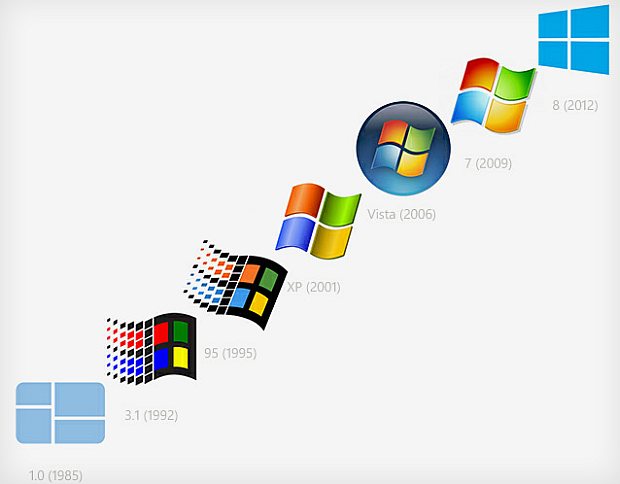
Just as a curious thing that you might know, Windows was originally named after the windows you could open, it was a revolutionary idea – everything before it was full-screen. It was what made it so different, so great. With the new Modern UI, Microsoft has taken a step back to its roots – the main user interface features no more windows, as DOS did not (Windows was actually an interface that made the DOS user interface better, not a standalone product, that changed with the 3.x series of Windows). A further proof that Microsoft has reverted to the old days of the 80’s is their logo:
With this, I finish this informative rant about how Microsoft has stepped into a blunder yet again. This is not surprising at all as Windows tends to flourish every second edition (95 was not very good, 98 was praised, ME had tons of bugs, XP was magnificent, Vista was hated, 7 was welcomed). Thank you for reading and have a good day.
“Darkness is Death’s ignorance, and the Devil’s time.” – Godfather of Soul
What is a soul? Is there such a thing? Or is it an old placeholder like God?
Since science is based on empiric observations, and the soul has been generally linked to and observed with neurological activity, one could easily define ‘soul’ as the relatively unique personality or personal mental traits belonging to an individual. But as cool as neurology is, this is dry and boring, let’s go deeper.
There is one extremely important bit in the previous point – a soul is for an individual. It defines who we are by our personalities and values we hold dear. SG-1 even went the extra mile by saying that a soul can exist indefinitely as pure energy, therefore not needing a rotting body. In SG-1, a soul could actually recreate its body. In common fiction, a soul tends to retain memories as well as personality, emotions, etc. This is particularly curious as a soul appears to be immaterial, thus it has no obvious way of storing all that information.
A solution to the data storage problem is to limit the soul to a particular body. This would not explain all the out-of-body experiences we have throughout our lives (the moments we see ourselves from a spot about 5-20 metres away doing something or going somewhere that only happen for mere moments), but it would solve the data problems – everything can be accessed from our memory. This comes dangerously close to the neurological explanation as limiting the soul to a body, and therefore a brain, brings up the problem of magnetic coercing and temporary changes in personality and judgement due to aimed magnetic pulses hitting certain parts of the brain. A simple enough problem that leads to a dead end on our quest for the soul.
Therefore we should assume that a soul is not limited to a brain, therefore not merely a neurological effect of a specific brain’s structure. In this case, out of body experiences, reincarnations and Saving Hope are quite sensible options – in the first case the soul is no longer contained in the mind, gets out, wants back in in order not to perish, and does. A mind is necessary for a soul, but a soul can inhabit more than one mind during its existence. In addition, apparently new souls manifest and many old souls cease to exist. Reincarnation would be caused by an out of body experience where returning to the mind is impossible, which would mean either one of two things happen. The first being the soul perishes due to a lack of a support structure (mind), the second being that the soul finds a fresh mind, a mind of a newborn. Whether that mind is already inhabited by a soul or not is up for theological debate (as is the question of the possibility of a mind accommodating more than one soul, i.e. a split personalities complex).
In this case, we can exclude the option of memories being transferred along with the soul (or, in the best case scenario, extremely few memories). But a personality can be transferred via soul – it takes very little space and its very existence appears to constitute a soul.
This leads to an opportunity for you – what do you want to believe? Do you wish to believe that the soul is merely a result of evolution, a side-effect of complexity… or is it something more, something that can move in time and space but requires a relatively stable environment for continued existence?